


If you claim to be a writer, then you may wonder whether using AI is dishonest. If you are a paying reader, you may question whether AI-assisted writing is worth paying for. If you have spent years developing a craft, you may be (understandably) reluctant to hand any part of it to a machine. Surely, the value is in the effort itself? To delegate to a machine would undermine the inherent value of the work? The answer — as is the case for many complex questions in life — is: it depends.
We are all experiencing the growing pains of change. Generative AI technology has advanced more quickly than the social agreements surrounding it. Our expectations of authorship, effort, originality, and fair use are being renegotiated while we are using the tools.
Our discomfort stems from an inherited belief that valuable work must (surely?) be difficult, slow, and visibly performed by the person whose name appears on the cover. AI is forcing us to ask an awkward question: if the result is useful, truthful, and unmistakably shaped by human experience and judgement, how much should we care about who physically wrote each sentence?
A real-life social science experiment:
The thought of using AI to help write something for publication still makes me viscerally uncomfortable. Perhaps the thought makes you uncomfortable too. It feels unethical. It feels immoral.
So I decided to run an experiment — and you’re a participant in the study!
You may be wondering why dozens of words and sentences in this article are highlighted orange. The truth is that the highlighted text is what I’ve written (or modified) myself. Anything else was generated explicitly by Codex (using ChatGPT’s ‘Work’ mode).
Surprised? I am, because I’ve had to re-read segments of it myself a few times to recall who wrote it. My writing and that of Codex are so aligned that differentiating between human vs AI text is challenging, even for myself.
Effort used to be part of the evidence
For most of history, skilled production was scarce. Yet, ever since Generative AI arrived on the battlefield, I’ve been wrestling with painful questions around:
Identity,
Professional value,
Time wasted developing skills that have been absorbed by technology, and
What does value even mean in a post-AI society?
A carpenter needed years of practice to shape wood well. An illustrator had to learn how to draw. A software engineer had to understand enough syntax and structure to turn an idea into working code. A writer needed to sit with a blank page and construct an argument sentence by sentence.
The labour was not only a means of producing the work. It became evidence that the work deserved respect. We learned to associate effort with care, difficulty with quality, and time spent with value created. Achieving mastery requires sustained time and effort, and hurried work was often poor.
That said: a badly designed report does not become useful because it took three weeks to write. A confusing interface does not become considerate because its codebase is technically impressive. A sentence nobody understands does not become more valuable because its author spent all afternoon wrestling with it.
Effort is an input, but value is an outcome.
This distinction becomes harder to ignore when a machine can reduce the effort without necessarily reducing the outcome. We are left defending not only the quality of our work, but the identity we built around producing it.
I found a story hidden inside 432 posts
I recently analysed an archive containing 270 of my LinkedIn posts and 162 of my Substack notes. Together, they formed a collection of 432 pieces of writing produced across several years.
The archive contained my ideas, experiences, professional interests, recurring themes, and changing priorities. It was a kind of accidental journal, scattered across two platforms and hidden inside hundreds of individual posts.
I wanted to know what the collection said about me. What had I repeatedly noticed? Which subjects had endured? Where had my thinking changed? Could I trace a coherent story through material that had originally been published one fragment at a time?
I could have attempted the analysis manually. I could have gathered every post, cleaned the text, removed duplicates, classified the themes, counted the patterns, created the charts, and compared the findings. In theory, nothing prevented me from doing it. But, in practice, I would never have found the time.
Using AI made the project viable. It helped me process the archive, examine the patterns, and turn a large, messy collection into something I could interpret. The result was the essay linked below outlining what those 432 posts revealed.
I analysed 432 of my old posts. Together, they tell a story.

Archaeologists, anthropologists, and historians spend their careers examining what earlier generations left behind. What looks like waste or scrap can become valuable evidence for so…
The machine did not attend the events I wrote about. It did not build my career, form my relationships, notice the moments, change its mind, or publish the original posts. It did not decide which findings felt significant or what the archive meant for my future. It just helped me to tell a story I had already lived.
AI did not simply replace the hours I might have spent processing the material. It enabled an enquiry that would otherwise have remained an unfulfilled idea in my notebook. AI made the unviable viable. It gave me time back. It unlocked both potential and creation.
The craft is not always the product
There is a difference between loving the craft and loving what the craft produces.
A woodworker may find meaning in selecting timber, sharpening a plane, and shaping every joint by hand. The process is part of the reward. A customer may value the provenance and gladly pay for something handmade. In that case, the method genuinely belongs to the product.
Another customer may simply want a beautiful, durable table that fits the room. They care whether it works, how it feels, how long it lasts, and what it costs. The hours spent making it only matter when they influence one of those outcomes.
Writing contains the same distinction. Sometimes writing is how I think. Slowing down, struggling with language, and discovering the gaps in an argument can be the point of the exercise. Delegating too early would remove the productive friction that helps an idea form.
At other times, the thinking has already happened. I have lived the experience, captured the observation, formed the opinion, and decided what I want to communicate. The remaining work is largely one of production: structuring, connecting, clarifying, and polishing the material so another person can use it.
Why should every project adopt the same methodology?
Software engineers have recited a version of this argument for years: users do not care about your technology stack. They care whether the product is reliable, usable, secure, and capable of solving their problem. The implementation matters enormously to the people responsible for maintaining it (i.e., the programmers themselves, who enjoy debating such things), but the technology stack and architectural decisions are rarely aspects the customer worries about.
The same principle applies to prose. Readers still need the writing to be engaging, clear, accurate, and worth their attention. They do not automatically benefit from knowing that I typed every word without assistance.
This does not mean the method never matters. If something is sold specifically as handmade, human-written, or created without AI, then its provenance is part of the promise. Misrepresenting that process would be dishonest.
But when readers are paying for useful ideas, lived experience, careful analysis, and a perspective they trust, the keystrokes are not necessarily the source of the value.
Human value moves to either side of production
After losing to IBM’s Deep Blue in 1997, Garry Kasparov did not conclude that humans had nothing left to contribute to chess. In 1998, he helped introduce Advanced Chess, in which people played with computers at their side. His model combined human intuition, strategy, and experience with machine calculation, tactics, and memory. Kasparov later argued that we should work with intelligent machines rather than define ourselves by competing against them.
The lasting lesson is not that a human-computer chess team will always outperform the strongest modern engine. Technology has continued to improve. The more useful lesson is that introducing a powerful machine changes the role of the human.
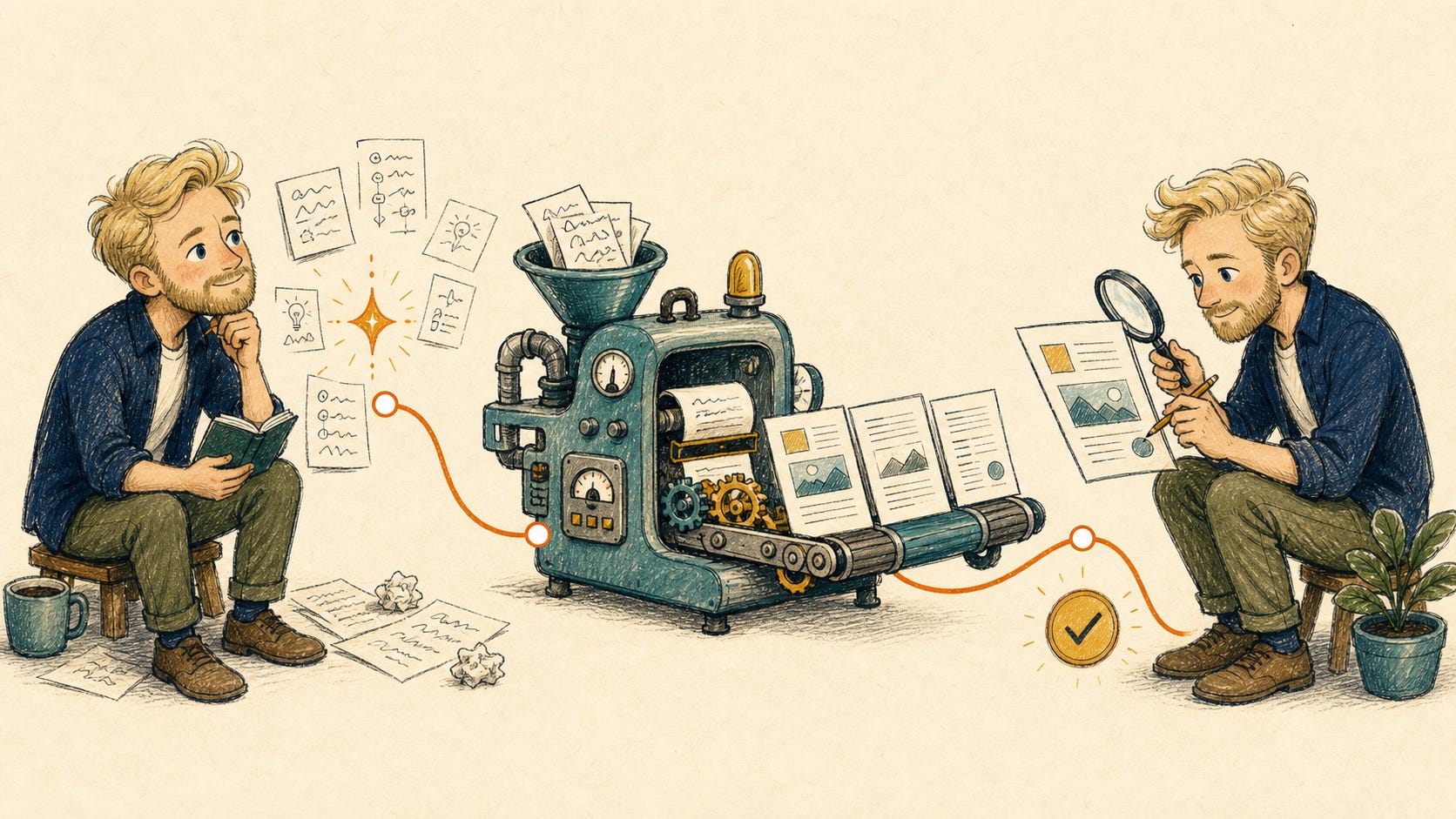
When production is commoditised or mechanised, humans become editors, curators, directors, managers, strategists, thinkers, and instructors.
Before production, we must simply observe: capture experiences, identify problems, ask worthwhile questions, choose a direction, and decide why something should exist. A machine can generate a thousand answers, but someone still has to choose the question.
After production, we must judge: verify claims, recognise weak reasoning, remove what does not belong, protect the truth of our experiences, and decide whether the result is good enough to carry our name.
The middle changes, but the outcome doesn’t. If anything, AI has simply raised the bar for what good enough looks like.
This distinction helps me choose my role more deliberately. Some projects invite me to be the craftsperson, immersed in the pleasure and difficulty of making. Others need me to act as the director or product manager, focused on what we are creating, why it matters, and whether all the parts serve the intended outcome.
Trying to perform both roles simultaneously is difficult. The craftsperson wants to perfect the current component. The director needs to step back and question whether the component should exist at all.
AI gives us the option to move between those roles. It does not decide which role a particular project deserves.
The bargain is not morally clean
None of this resolves the legitimate concerns surrounding how generative AI was developed.
These systems depend on vast quantities of human-created material. Writers, artists, publishers, developers, and other creators have questioned whether their work was used with meaningful consent, transparency, or compensation. The benefits available to users cannot be separated entirely from the contested methods used to create them.
The law has not produced a simple answer. In its 2026 Report on Copyright and Artificial Intelligence, the UK Government recognised that frontier models often depend on copyright works, that their outputs may compete with the creators from whom they learn, and that significant uncertainty remains around licensing, transparency, labelling, and reform. It also distinguished between wholly AI-generated content and the more nuanced reality of AI-assisted creative work.
We should resist two convenient stories.
The first is that using AI is automatically unethical, regardless of what the human contributes or how the tool is used. The second is that usefulness absolves us from questioning how the technology was built.
I can object to aspects of the bargain while acknowledging that I would now be reluctant to surrender what the technology enables. That contradiction is uncomfortable, but pretending it does not exist would be less honest than admitting it.
The same honesty should extend to the work itself. “Did the reader receive value?” is an important question, but it is not the only one. Others are:
Are my experiences genuine?
Do I actually hold the beliefs expressed?
Have I examined the argument and checked the factual claims?
Does the finished piece represent what I intended to say?
Am I willing to accept responsibility when it is wrong?
If AI invents an experience I never had, introduces a conviction I do not hold, or produces a claim I publish without scrutiny, the work becomes misleading. If I remain responsible for the source material, direction, verification, editing, and final judgement, then authorship is doing more work than typing alone.
Authorship and accountability must walk hand-in-hand.
From a ‘bias for action’ to a ‘bias for thought’
The advice to develop a ‘bias for action’ is useful when organisations can spend months discussing an idea before anybody builds enough of it to learn whether it works. Moving quickly can create an advantage.
But what happens when action becomes almost effortless? When we can generate another article, prototype, image, analysis, or product concept within minutes, producing something is no longer evidence that we chose wisely.
We need to develop a stronger bias for thought. Not endless deliberation. Not hesitation dressed up as rigour. But thoughtful direction:
What are we trying to change?
Who is this for?
Why should it exist?
What would make it useful?
What must remain human?
What are we unwilling to delegate?
This makes the humble notebook more valuable, not less. The observations we capture, questions we record, connections we notice, and experiences we reflect upon become fertile soil for work that AI can later help us develop.
Interesting side note: when I was a first-year student at the University of Birmingham, Professor John Nolan CBE of Nolan Associates recommended that we each carry a notebook with us, at all times, to capture interesting structural details as we stumbled upon them. He suggested that such records prove useful fertile soil for inspired work later in your career. This was in 2016; his words may be truer now than ever before.
Perhaps that is why this transition feels so personal. We are not merely adopting a new tool. We are revising the story we tell ourselves about what makes us useful.
For years, many of us proved our value by producing. We wrote the sentences, drew the images, constructed the models, prepared the slides, and assembled the analysis. The visible labour helped form our professional identities.
Now we are being asked to believe that noticing, choosing, directing, interpreting, and taking responsibility are not lesser forms of work. In many cases, they were the most valuable parts all along.
I do not want to stop writing. But I do want to stop treating manual production as a moral requirement when another method would let me explore more ambitious questions, conduct richer analysis, or share a useful idea while it still matters.
The words still matter. The hours spent typing them matter less.
When production is mechanised, the work begins with the life we live, the gems we notice, and the questions we pose. It ends with the judgement we exercise, the truth we protect, and the responsibility we accept for whatever carries our name.
Human value has not diminished; it’s been transformed.
In some cases, it’s been unleashed.
Stay thoughtful.
James.
P.S. I counted ~400 orange highlighted words in this article. There are a total of 2430 (excl. this footnote) according to the Editor word count. That means that around 16.5% of this article was manually written or modified by me. Does this shock you? If so, leave a comment below or reply to the email. I’ll read each and every one (manually!) and get back to you.