



Archaeologists, anthropologists, and historians spend their careers examining what earlier generations left behind. What looks like waste or scrap can become valuable evidence for someone asking the right questions. As the world moves ever faster, our instinct to consign the past to forgotten archives may cost us more than we realise.
Social platforms teach us, rather unfortunately, to treat writing as temporary. We publish a thought, watch and hope that it gathers a little attention, reply to a few comments, and move on. Within days, it has disappeared beneath everything that came afterwards. The world forgets and so do we. But maybe we needn’t be so hasty in our reckless abandon. With a little effort, curation, and curiosity, you can learn a great deal about yourself and how you’ve evolved by analysing your past writing.
Over the past few years, I have shared hundreds of ideas across LinkedIn and Substack. Some became detailed reflections. Others were brief observations captured in a few sentences before the thought disappeared. Individually, they often felt small and disconnected. Together, I suspected they might tell a story: a developmental archive of the subjects I return to, the questions beneath them, and the gradual shift in my thinking and my interests.
So I grabbed a shovel and started digging.
Building the archive
I collated two original sources:
A very large PowerPoint file containing screenshots of 270 LinkedIn posts, including the engagement data visible in those captures.
57 PowerPoint slides containing screenshots of my Substack Notes.
Whilst reading everything manually would have been possible, turning it into a consistent, searchable archive would have been a far more daunting undertaking. I decided to see if AI could streamline the process.
Working with Codex, I began converting the material into something structured and reusable. The LinkedIn screenshots were extracted, processed with optical character recognition (OCR), and assembled into a structured comma-separated values (CSV) dataset. Every resulting record was then inspected. The 57-slide Substack presentation was examined separately.
Screenshots containing several Substack Notes or LinkedIn posts had to be separated into individual entries. My original writing needed to be distinguished from material I had merely restacked or reposted. Where I had added commentary of my own, that contribution was retained. Each entry received a unique identifier, working title, primary category, supporting themes, source location, and any available engagement data.
The finished Markdown archive contains 270 LinkedIn captures and 162 distinct Substack Notes or commentaries, producing 432 catalogued entries across the two sources. That total describes the archive, rather than 432 entirely unique ideas. Some thoughts appeared on both platforms, and those overlaps were intentionally preserved because the way an idea travels is part of its history.
I had transformed hundreds of disconnected posts into a catalogue.
What have I been writing about?
Every entry was assigned one primary working category, even though many naturally crossed several boundaries. A reflection about AI, for example, might also concern work, identity, design, business, or human behaviour. The taxonomy is not absolute. It is a practical way to expose the archive’s centre of gravity.
Rather than presenting the category index as a table, it is more useful to read it in three broad bands:
The dominant themes were engineering, design, and systems, with 86 entries, followed closely by intentional living, simplicity, and growth, with 76.
A substantial middle formed around social media, platforms, and online community, with 50 entries; technology, AI, and digital tools, with 42; relationships, kindness, and human experience, with 41; and writing, creativity, and publishing, with 35.
The longer tail included work, career, and professional growth, with 26 entries; travel, place, and everyday life, with 21; learning, curiosity, and ideas, with 18; leadership, teams, and culture, with 16; wellbeing, mental health, and rest, with 12; and business, entrepreneurship, and value, with nine.
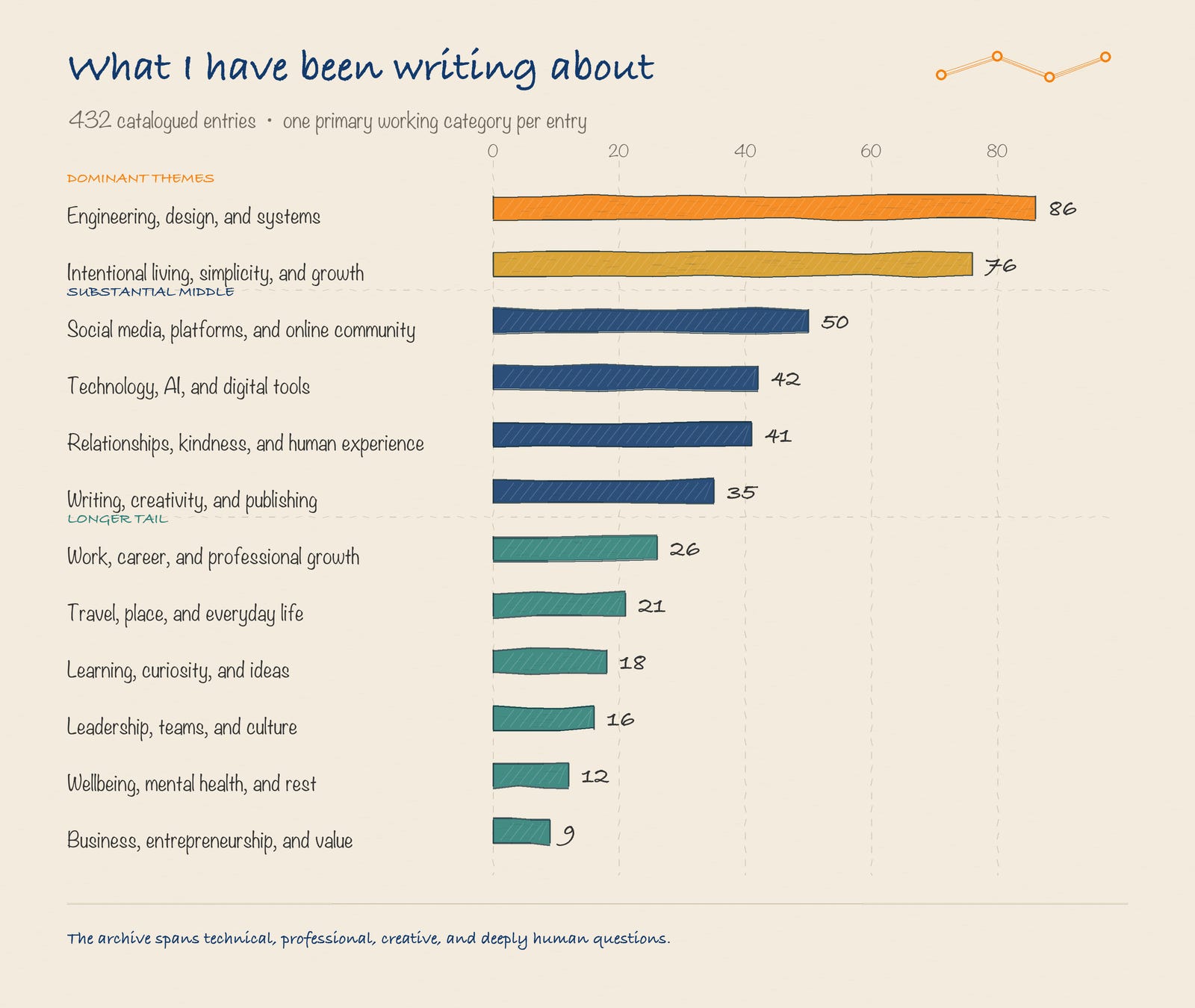
What surprised me was not the volume, but the coherence. Ideas published months or years apart were often examining the same underlying concerns. Again and again, the archive returned to questions about how we make work feel better, how thoughtful design can reduce friction, what meaningful progress looks like, how we might use technology without losing our humanity, and what it means to live with greater simplicity, clarity, and intent.
Even when the subject changed, the deeper fascination often remained the same. It turns out I have been writing variations of the same few essays for years. I simply did not know that they belonged together.
From technical to socio-technical
The archive also revealed a clear evolution in my thinking. My early writing was heavily professional and technical. I wrote about structural engineering, software, digital tools, projects, industry developments, and technologies I found interesting. The central question was often straightforward: what is useful, new, or technically interesting?
Everyone is capable of both deep interest and boredom. Move toward what interests you and away from what bores you. - Bill Gurley, Runnin’ Down A Dream, p. 31
Engineering and technology accounted for approximately 40% of my early LinkedIn archive. During a later period of deeper interest in AI, software development, and toolmaking, engineering, design, and technology rose to more than 53% of the category mix. It was the most technically concentrated phase in the collection.
Over time, however, the system boundary began to expand. Writing about tools led me to consider the systems around them. Systems thinking drew me towards UX and Experience Design. Experience Design opened questions about psychology, accessibility, motivation, work, and human behaviour. The question was no longer simply whether a system worked, but how it shaped the people using it.
The category mix reflects that movement. In my more recent LinkedIn writing, the combined share of engineering and technology fell to approximately 34%. In my current Substack Notes, it is below 12%. Intentional living, online community, writing, publishing, relationships, and wellbeing have moved towards the centre instead.
These percentages should be treated as directional rather than exact. Nevertheless, the movement is clear. The progression is best summarised as:
tools → systems → experiences → people → meaning
What looks like a radical shift is actually a recognition that engineering is broader than a technical discipline. At its heart, great engineering is socio-technical; it recognises that both people and planet are players within the holistic system and that our artificial constructs must respect that.
Engineers define boundaries so that problems can be understood and solved. Draw a tight boundary around a piece of software and the focus is its code, architecture, reliability, and performance. Expand it slightly and interfaces, workflows, integrations, and operating environments come into view. Expand it again and you encounter organisations, incentives, communication, culture, and decision-making. Eventually, you reach the person experiencing it all.
That person may be confused, inspired, exhausted, motivated, excluded, delighted, or completely indifferent. The technical system cannot be separated from the human experience surrounding it, and my writing appears to have followed the same outward movement. I began with the artefact, then became interested in the system, the experience, and the person. Increasingly, I find myself interested in meaning: what the work is for, whom it helps, how it makes somebody feel, whether it reduces friction, and whether it leaves a person, organisation, community, or world in a better state than it found them.
My gravity has shifted. I now see the person experiencing the system as the key component.
Small ideas compound
Social platforms encourage us to evaluate posts individually and immediately. We publish something, observe its performance, and allow the algorithm to bury it. Yet a short post can be an early expression of something much larger. It may contain the seed of an essay, framework, talk, product, research question, or book chapter. Its value is not always visible when the thought first appears because patterns emerge through accumulation.
One post about workplace frustration may be a passing observation. Twenty posts about friction, motivation, systems, and job satisfaction may reveal a body of work. One note about simplicity may feel inconsequential. Dozens of reflections about minimalism, intentional living, and effort well spent may reveal a personal philosophy.
A post is not necessarily the finished thought. Sometimes, it is only the first sketch. You write something, return to it from another angle, and test it against new experience. The language becomes clearer. Separate ideas begin to connect. Eventually, you realise that you have not been publishing random thoughts at all. You have been circling a set of enduring questions.
Know someone who’d enjoy TEE™?
From content graveyard to editorial map
I no longer think of my old social posts as a content graveyard. They form an editorial map: a searchable record of how my thinking has developed, which subjects have remained stable, which interests have faded, and which questions have become more important with time.
It is also valuable source material for future TEE™ essays. I can now gather every observation I have made about a subject, compare older and newer positions, identify contradictions, and combine fragments into a more complete argument. The archive makes it easier to see which ideas deserve a full essay, which themes might become recurring sections, where my thinking has materially changed, and which questions I have repeatedly approached without answering. It can reveal posts that belong together, gaps in my knowledge or evidence, and ideas that may eventually become frameworks, talks, tools, or books.
What might your archive reveal?
If you have been writing online for several years, your archive may contain more value than you realise. Begin by gathering what you have already published. Preserve the original text, dates, links, and whatever performance data remains available. Give each entry a title and category, add a few supporting themes, and flag anything incomplete or uncertain.
Then stop looking at posts in isolation. Look for repetition and movement. Notice the subjects that keep pulling you back, how your language has changed, and where your professional interests have begun to connect with your values and lived experience. Pay attention to the ideas that have become more personal, practical, or ambitious over time.
Your archive may show you what you have been trying to say all along. More importantly, it may show you what you should write next. Small ideas compound when you give them somewhere to live. So your past may teach you more about the person, thinker, or writer you are becoming.
Stay thoughtful.
James.
This actually inspired me to do the same.
I went back and reviewed a full year of my own writing, and what I found was surprisingly interesting.
I realized that my interests are broader than structural engineering itself.
A lot of what I write about comes back to the same questions:
How do engineers think and make decisions when reality becomes complicated?
How do systems, incentives, pressure, uncertainty, and human behavior shape the outcomes of our projects?
And what lies beneath the problem we can actually see?
Whether I’m talking about FEM, structural behavior, codes, project delays, clients, communication, leadership, or organizational culture, I seem to keep coming back to the same ideas:
**Engineering judgment matters as much as calculation.**
**The visible problem is not always the real problem.**
**Pressure reveals our priorities.**
**Systems often shape behavior more than individuals do.**
And **good decisions require understanding the bigger picture, not just optimizing one part of it.**
Perhaps the common thread in all of this is simple:
**I’m interested in what lies beneath engineering decisions — structural behavior, human behavior, system behavior, and the decisions that connect them.**
Thanks for the inspiration. It was a surprisingly useful exercise.